PHOENIX — Republicans who control the Arizona Legislature plan to give Democratic Gov. Katie Hobbs what she's been seeking for months: their budget plan for the state fiscal year that starts July 1.
But the negotiations she also demanded — ones she walked away from a month ago, saying GOP lawmakers refused to show her their competing budget plan — aren't in the mix for now.
Instead, Senate Majority Leader John Kavanagh and House Appropriations Committee chair David Livingston told Capital Media Services on Thursday that Republicans plan to introduce their budget plan and have the House and Senate vote on it this coming week. Both say they have enough Republican votes for it to pass without any help from minority Democrats.
"We don't negotiate with the Democrat legislators and make compromises and then go to the Democrat governor and make more compromises,'' Kavanagh said. "Besides, this is not a compromise budget.
People are also reading…
"The governor said she wants to see our budget," said Kavanagh, a Fountain Hills Republican. "She's got it. This is the budget. And, you know, we expect this to be the final budget.''
Hobbs released her $18.7 billion spending plan for the coming fiscal year in January that relied in part on increases in taxes or "fees'' on short-term rentals like Airbnb, on sports betting companies' profits, and on new data centers, as well as more than $80 millions in savings by cutting the state's universal school voucher program. She also inked in nearly $760 million in revenue from the Trump Administration to reimburse the state for money it has spent on border security since 2021 — money Arizona has yet to see.
None of that made the cut into what Livingston, a Peoria Republican, called "the most conservative budget'' Hobbs will sign in her four years in office.
If she signs it.
Hobbs spokesman Christian Slater declined to comment on whether she would approve the GOP spending plan, saying the governor has not yet seen it.
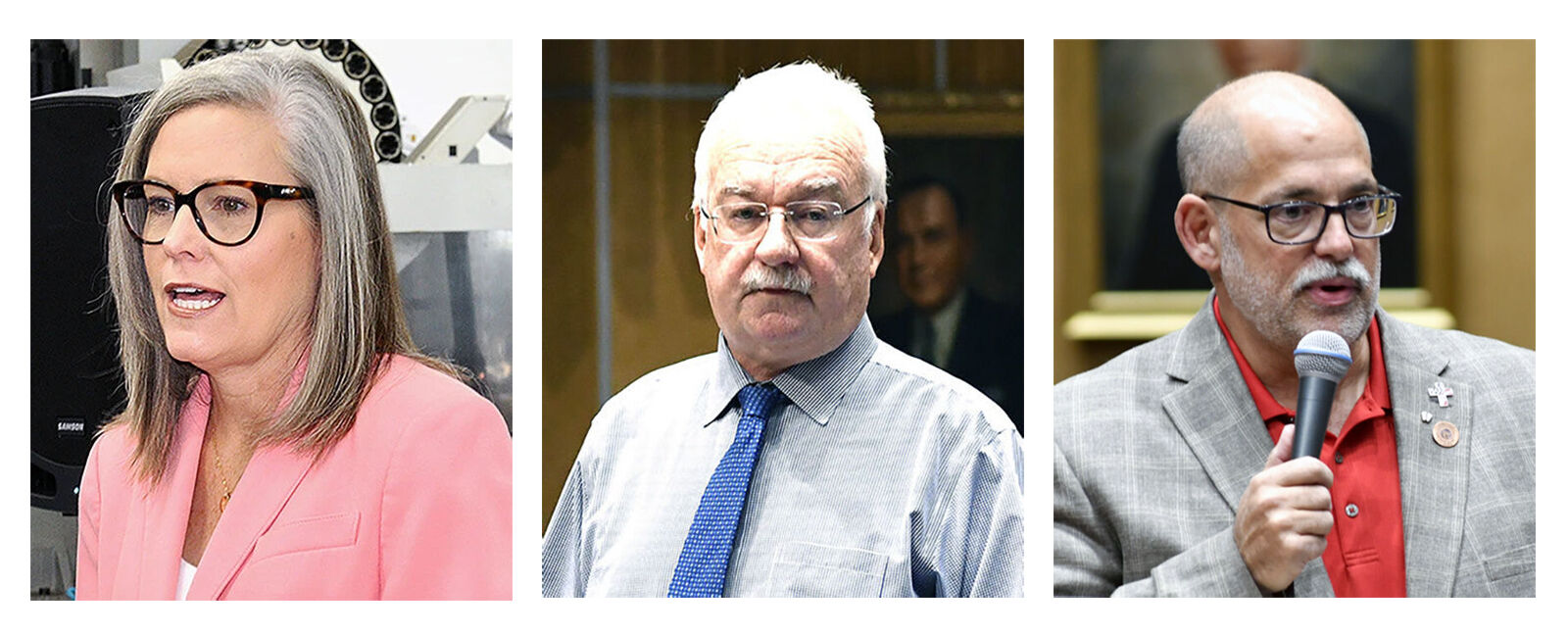
From left: Gov. Katie Hobbs, Senate Majority Leader John Kavanagh and House Appropriations Committee chair David Livingston face a challenge in coming to agreement on a budget for Arizona by July, the start for the fiscal year.
Slater also would not say if she would lift her April 13 vow to veto every bill that reached her desk until Republican lawmakers "show the people of Arizona their budget proposal and engage in serious negotiations,'' according to the news release announcing her veto threat.
Instead, he provided a statement highlighting how Hobbs has waited more than 100 days since the Legislature convened for the GOP to release their spending plan.
"We look forward to seeing the details of their proposal and delivering a budget that cuts taxes for the middle class, funds public education and lowers costs for Arizonans that are struggling because of Washington's harmful, price-hiking policies,'' the statement said.
What GOP lawmakers are including in their budget plan instead of Hobbs' priorities is "full conformity'' with the tax cuts included in President Donald Trump's "One Big Beautiful Bill'' that passed last year.
That tax and spending bill also cut Medicaid, food stamps (now called the Supplemental Nutrition Assistance Program) and other social programs to pay for big income tax cuts, including provisions like much bigger write-offs for state and local taxes, an increased standard deduction and no tips on overtime or tips.
And the GOP budget spends about $900 million less than the governor's proposal, coming in at $17.8 billion, Livingston said. While Kavanagh wouldn't talk much about the GOP plan, saying all GOP members hadn't yet been briefed, Livingston gave a few more details.
"So it's a skinny budget, it's a baseline budget,'' he said, referring to the baseline that the Legislature's budget analysts compile each year using the previous year's spending plan plus inflation adjustments for schools and other baked-in increases.
In a year with little spare cash laying around, "we have sweeps (from special state accounts) and we have agency cuts, to fund tax conformity,'' he said.
Livingston noted that during budget talks during her first three years in office, Hobbs has demanded that the Legislature wait until April revenue numbers come in before they begin work in earnest on a spending plan.
"So we did that — that's what they wanted,'' Livingston said.
"They came out,'' he said. "Couple hundred million dollars short. We put it in the new budget, and now we're rolling it out on Tuesday.''
Hobbs walked away from budget talks a month ago, saying it made no sense to keep talking if Republicans didn't show their proposal so they could work out the issues between them.
The two sides had hammered out some details, including agreements on continuing to fund a raise for corrections officers, state employee health care and money for school building repairs, Slater said.
Livingston said some of those items remain in the GOP plan.
Not included is anything that relies on the renewal of Proposition 123, the voter-approved 2016 measure that boosted withdrawals from the state land trust to pump $3.5 billion into K-12 schools over a decade to settle a lawsuit filed by schools over the legislature's illegal funding cuts following the Great Recession.
Proposition 123 expired last year, and the legislature used general fund cash to replace about $300 million in lost funding. That money is now in the "baseline'' and will again flow to schools in both the governor's and GOP budget plans.
Livingston said new education revenue from a possible extension won't be used to help balance the coming budget.
That's because even if the Legislature agrees to put a renewal on the ballot in November, the money won't flow until 2027 — assuming voters give their approval. And Hobbs and Republicans haven't been able to agree over the past two years on how a renewal might be structured: where schools could spend the money and whether to add items some Republicans want, like enshrining universal school vouchers in the state constitution.
Livingston said Hobbs should not expect action on new programs she asked for in her budget, like expanding utility assistance for low-income Arizonans and boosting child care assistance.
"We're really not doing anything extra for the governor, he said.
"We have one (GOP) member request — full tax conformity — and we're not doing any other member requests,'' he said, nixing any of the special items like local road improvements that often lard a budget to win support from individual lawmakers. "That is our message as Republicans, that we will be, I believe, possibly, the first state in the country to do full tax conformity and make it permanent.''
And while last year saw House and Senate Republicans at odds well into June over how to negotiate with Hobbs — leading to a veto of one spending plan before a second passed only with the help of Democrats — Livingston said this year is very different.
Republicans at this point plan to introduce identical budget bills in the House and Senate on Monday and doing the needed procedural steps to get it ready to move.
On Tuesday morning, a joint meeting of the House and Senate appropriations committee will be held, always a daylong affair that is the public's only change to comment on the plan and try to persuade GOP lawmakers to add items.
That's happening "physically in the House, but we're doing it together,'' Livingston said.
"And it's a big deal that we decided to do it together — the leadership and the appropriation side,'' Livingston said. "That's just how unified the House and the Senate are this year, between the membership teams, between the appropriation chairs and members in the leadership.''
That unity in large part steps from the fight over tax conformity. Republicans wanted Hobbs to call a special session of the Legislature late last year to pass a law putting much, if not all, of Trump's tax cuts into Arizona law. Hobbs never acted.
And shortly after the Legislature convened the 2026 session, Republicans passed a conformity bill that enacted most of the tax cuts while skipping others, like write-offs for state and local taxes that aren't as important in low-tax Arizona than in some states with high property taxes. It instead contained larger childcare and child tax credits, but Hobbs vetoed it.
She also axed a second GOP conformity package in February that contained most of the federal provisions and matched what Hobbs' Department of Revenue used on its tax forms.
Now, Livingston and Kavanagh said, Hobbs has painted herself in a corner, since the April 15 tax filing deadline has passed and millions of Arizonans have filed their returns based on guidance from the state the governor contradicted in her conformity proposals.
"There is no way in hell that we are not doing full tax conformity for everybody in Arizona who's already filed tax returns based on Department of Revenue, full tax conformity forms that they put out,'' Livingston said.
"And the way the budget works, because we do a three year rolling budget, if we don't continue the tax conformity, that shows that we're increasing taxes in year two or three, and there's not a chance in hell we're doing that either,'' he said. "So the governor has put herself in a very bad position, not understanding how tax conformity works, not understanding what her Department of Revenue did with the tax forms. And here we are, but we understand.''
In contrast to Kavanagh, Livingston didn't completely close the door on working with Hobbs after the GOP plan is released.
"If the Governor's team, if (her chief of staff and budget director) and Governor Hobbs want to negotiate with us and do amendments, I think we're open to that,'' he said.