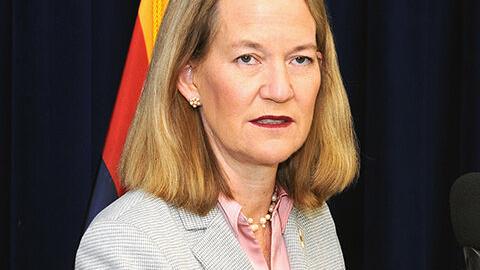
PHOENIX����� Attorney General Kris Mayes acted illegally in withholding some information about communications her office had with States United Democracy Center, a group that provided information on how she could bring charges against "fake electors,'' the state Court of Appeals has ruled.
The judges said that Mayes, in seeking to keep some documents from Judicial Watch, argued that they are protected by attorney-client privilege or that they fell into the area of being a work product. Both of those kinds of materials are generally exempt from the state's public records law.
But the court said Mayes, in making that claim, was required to produce an index of the documents withheld that is sufficient to show she did not have to surrender them. She failed to do this, said appellate Judge Jeffrey Sklar, writing for the unanimous three-judge panel.
People are also reading…
The new ruling does not mean Mayes will now have to turn over the documents to Judicial Watch, which describes itself as a "conservative nonpartisan educational foundation'' that uses state and national public records law to investigate government activities. Its focus, in part, is on what it sees as election integrity and voter registration issues.
What it does mean is that, unless the ruling is overturned, Mayes now must go back and provide a more detailed description for Judicial Watch and for the trial judge of what documents were withheld����� they appear to fall into the area of communications between her lawyers and people at States United����� and exactly why she believes they are not subject to disclosure.
In turn, that would allow the trial judge to rule whether Mayes has a legitimate legal reason to refuse to turn over the materials and, if not, to order her to surrender them.
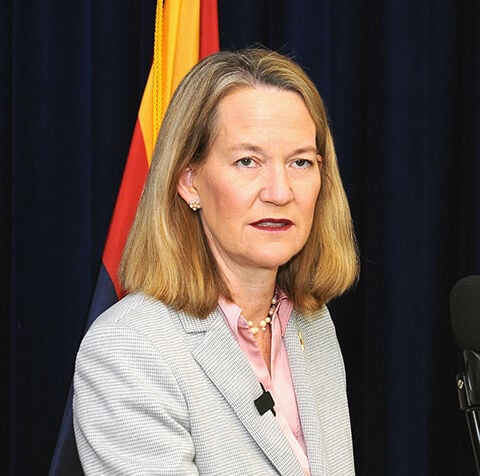
Mayes
A spokesman for Mayes said the office has no comment on the court ruling.
This legal fight was prompted by the discovery that States United, which describes itself as nonpartisan but has worked on Democratic issues, prepared a memo for Mayes in July 2023 as it was investigating events leading up to 11 Republicans signing a document after the 2020 election claiming that Donald Trump had won the Arizona presidential race. That signing occurred despite the fact that Trump lost Arizona to Joe Biden by 10,457 votes.
The Republicans' document was sent to Congress, a move the Attorney General's Office has said was part of a national plan to throw Biden's win in the presidential race into doubt and have members of Congress declare that Trump had won reelection.
Judicial Watch, on learning of the work done by States United, filed a public records request for the memo as well as all communications between Mayes' office and the organization.
Some of that eventually became public.
A copy of the memo, obtained by Capitol Media Services, shows that States United provided not just a detailed timeline of the events leading up to the signing of the false certificate but also a list of charges the organization said could be brought against the "fake electors" and others involved in the scheme.
Judicial Watch wanted more, such as communications between Mayes' office and States United. Some of the requests were answered not with documents but instead with an index simply declaring they were exempt from the public records law.
The appeals court said that was legally insufficient to allow Mayes to unilaterally reject the request.
"Index entries must contain more than generalities,'' Sklar wrote.
"Rather, an index must include specific assertions explaining why the document is purportedly privileged to the greatest extent possible without revealing its content or otherwise violating the privilege,'' the judge said. That means any public official seeking to shield materials must "sufficiently describe the communications to allow assessment of the asserted privilege," he wrote.
What Mayes provided doesn't comply with that requirement, Sklar said.
"The index provided by the Attorney General's Office supplies no context about the withheld emails that would allow a court or any other party to determine if a privilege applies,'' the judge wrote. "We thus agree with Judicial Watch that the privilege log's insufficiency prevented the trial court from adequately scrutinizing the office's privilege assertions.''
Separately, the appellate court concluded the Attorney General's Office did not search for all the documents that were responsive to Judicial Watch's request. The judges said that's because the office imposed both date and keyword searches.
Everything Judicial Watch is seeking is related to the criminal charges brought by Mayes' office against the 11 Republicans who signed the election certificate and seven other associates of Trump, all accused of multiple criminal charges, including fraud, forgery and conspiracy. Trump himself was named an unindicted co-conspirator.
Two defendants have had charges dropped after entering into deals, and a third pleaded guilty and was placed on probation.
Efforts to pursue the remaining defendants are currently on hold after a trial judge said prosecutors withheld relevant information from the grand jury that handed up the original indictment. Mayes has appealed that ruling to the Arizona Supreme Court.
Richie Taylor, a spokesman for Mayes, has declined to say what information her office was seeking from States United when the contract was signed on May 15, 2023, nearly a full year before there was an indictment.
Taylor, however, said the work States United did on the case was "separate from the independent investigation'' by the Attorney General's Office. He said it included "publicly compiled information.''
The memo obtained by Capitol Media Services shows there was more involved than a historical narrative, however.
For example, States United listed six specific state laws it said were violated: forgery, tampering with a public record, criminal impersonation, presenting a false instrument for filing, fraudulent schemes and artifices, and conspiracy. It also went into great detail on why each applies in this case.
The final indictment by Mayes' office used three of those����� forgery, fraudulent schemes and artifices, and conspiracy����� and added a lower-level felony of fraudulent schemes and practices.
States United also went on to describe potential defenses that those indicted could claim, including that they had no "unlawful intent'' but instead were relying on the advice of counsel. But the attorneys at States United told Mayes' office that to do that, the defendants would have to waive their attorney-client privilege, which could expose to the public and prosecutors other communications they had with their lawyers.
The memo also went into detail on why Mayes' office could indict those involved even though the events dated back to late 2020. It said that, in general, the statute of limitations for these crimes is seven years.
It also sought to give Mayes some cover if questions were raised about why she would be seeking indictments years after the event.
"Thorough investigations of complex cases take time,'' the memo said. It also noted that Mayes herself wasn't elected until 2022 and took office in early 2023.
Howard Fischer is a veteran journalist who has been reporting since 1970 and covering state politics and the Legislature since 1982. Follow him on X, ��and Threads at @azcapmedia or��email��azcapmedia@gmail.com.