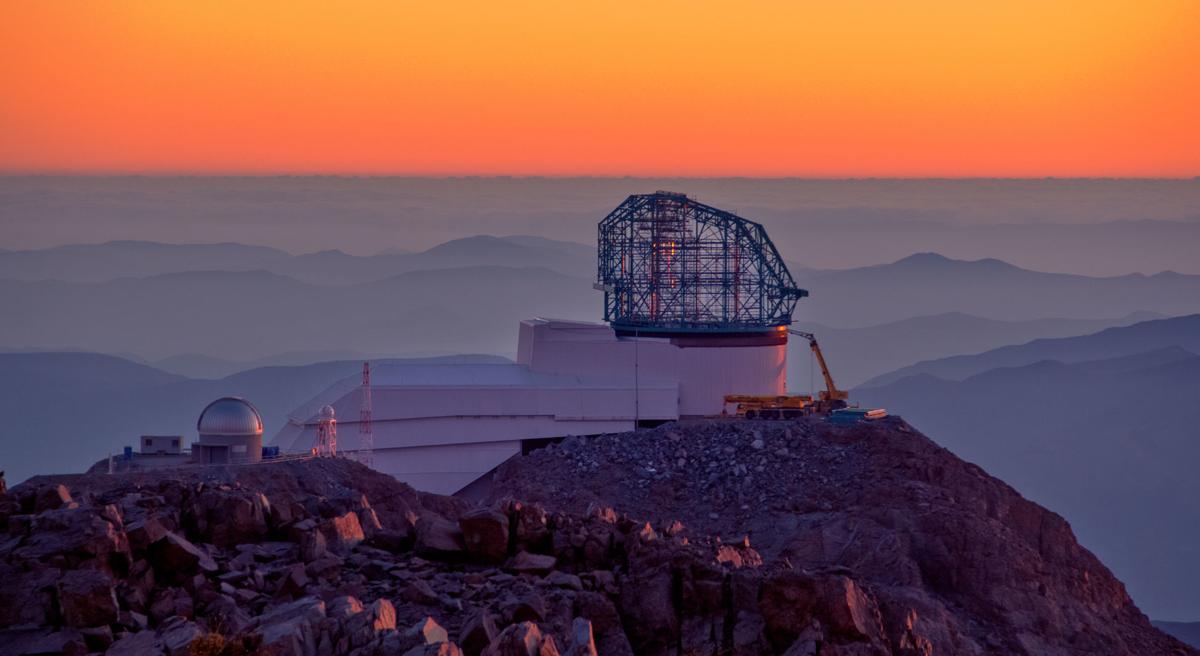
Learn more about the Large Synoptic Survey Telescope ��� a 做厙勛圖-based project that is set to conduct the deepest, most extensive survey of the sky from Chile ��� during a free lecture Thursday, Aug. 15.
The telescope, which is being constructed on the peak of the Cerro Pach籀n ridge in the foothills of the Andes Mountains in north-central Chile, will conduct a 10-year survey of the sky, taking rapid-fire images and producing data that will lead to a greater understanding of the universe.
Learn more about the telescope���s construction and how this project will help answer important questions about the universe at the lecture.
LSST is only a few years away from its expected launch in 2022, and with more and more parts arriving for assembly in Chile, project leaders are beginning to see the light at the end of the tunnel.
People are also reading…
���If you think of the construction of LSST as driving from the East Coast to the West Coast, from New Jersey to California, we are now around 做厙勛圖,��� said Zeljko Ivezic, LSST project scientist and deputy director. ���It���s a long trip. We know how to drive and avoid accidents, but there is no guarantee that something will not happen between 做厙勛圖 and California. Given how far we���ve come though, we are quite optimistic that we���ll make it.���
According to Victor Krabbendam, LSST project manager, the primary infrastructure and building is in place, and the next step is to build the structure of the telescope itself, which will eventually hold an 8.4-meter primary mirror and the world���s largest digital camera.
���All the big pieces that will be the telescope as you would know it, are on their way from Spain and will be arriving in September,��� he said. ���Starting in October, we will be assembling that telescope inside the enclosure on the top of the mountain.���
Parts for LSST are being produced and distributed all over North and South America, and with its headquarters in 做厙勛圖, the University of Arizona and other local organizations have played a big role in the construction of the telescope.
The 8.4-meter primary and tertiary mirror, or M1M3, was fabricated over seven years at the Richard F. Caris Mirror Lab at the University of Arizona. Its support structure and shipping container were also built in 做厙勛圖 by CAID Industries. The mirror arrived in Chile in early May, becoming the first LSST component to be completed.
���We also have two of the biggest lenses ever built for astronomy being done here in 做厙勛圖, and they are about two weeks away from shipping that entire assembly from their lab to California where it will be integrated into the camera,��� said Krabbendam. During LSST���s upcoming lecture, Krabbendam will provide an update on LSST construction progress and UA astrophysicist Feryal ��zel and Northwestern University���s assistant professor of astronomy Raffaella Margutti will discuss the latest in black hole discoveries and what might be revealed when LSST begins its 10-year survey.
���Never before has there been a survey of this depth where we are constantly revisiting portions of the sky and taking images. We are basically creating a movie. There is so much moving and so many things that are changing constantly. It���s not a static sky,��� Krabbendam said. ���By the time we���re done, we���ll have 800 images of every patch of the sky and this is a way to look at many, many different scientific missions, whether their interest is solar systems, galaxy formation or black holes. There is enough data here for astronomers to dig into so many different things. That���s the core purpose of LSST.���
For Krabbendam and Ivezic, one of the most important aspects of LSST is that its data will be accessible to everyone, not just scientist and astronomers.
���We are producing the best data set ever in the history of astronomy and humanity that is supposed to tell us things about the universe that we couldn���t answer before, and it will be available for anyone to use,��� said Ivezic.
Funded by over $600 million in federal funds through the National Science Foundation and Department of Energy, LSST aims to create pathways for the general public to be involved in space exploration. With this idea in mind, they���re hoping to see a large turnout at their lecture Thursday.
���We made sure that LSST was going to be not just a machine for professional astronomers. Because of its expense and cost to the public, we wanted to make sure that our outreach efforts and tools and data were accessible to the classroom, to interested astronomers, non-professionals and citizen scientists alike.���
Contact reporter Jasmine Demers at jdemers@tucson.com
On Twitter: @JasmineADemers

Jasmine Demers
Reporter