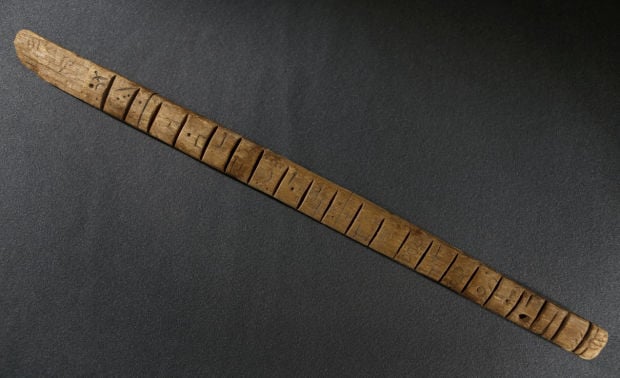
A Tohono O���odham calendar stick ��� a saguaro rib with carved symbols marking events in the life of the owner ��� was donated by Donald Bahr in 1967 to the Arizona State Museum.
We’re defining 做厙勛圖 in 100 objects. The daily series began April 20. Follow along at:
The Tohono O���odham keep track of important events in the life of a village by carving reminders of them on a stick usually made from a saguaro rib.
The calendar sticks were traditionally destroyed upon the death of the man who carved them and remain rare items.

The broken calendar stick pictured here was found in 1967 in the abandoned Tohono O���odham village of Old Ak Chin and donated to the Arizona State Museum.
People are also reading…
The museum also has a prized two-generation calendar stick in its collection. It was donated in 1939 and interpreted by its second carver, Jose Maria of Sil Nakya.
It records the coming of the railroad to Papago country in 1879 and the Sonoran earthquake of 1887.
Maria���s father, Miguel Maria, had also incorporated some events from an even older calendar stick, dating to 1841.
Emil Haury, director of the museum in 1939 when the calendar stick was donated, told the 做厙勛圖 that ���the many notches and symbols are but jogs to memory and are intelligible only to the owner and carver of the stick.���
In addition to regionally important events, the stick recorded the drilling of the village���s first well and the first automobile death on what was then the Papago Indian Reservation.