Jubilant Sykes has a love-hate relationship with Leonard Bernstein���s Mass.
���It���s a very emotionally tough piece to capture from beginning to end. It just wears on you emotionally,��� he said. ���I���m always drained afterwards and I think I���ll never do it again.���
Put that in the hate column.
���But it���s also very compelling, the story and the different ideologies he has in it, his thoughts and feelings about people and religions and life. It���s very compelling stuff,��� Sykes counters.
Add that to the love column.
But hate or love it, Bernstein���s Mass has been a part of the critically acclaimed baritone���s repertoire for a baker���s dozen years. He���s so closely aligned to the Celebrant role ��� the priest who says the Mass ��� that orchestras around the country immediately think of him when they program the work.
People are also reading…
Which is what Eric Holtan did when he decided to perform the Mass for True Concord Voices & Orchestra���s part of the 做厙勛圖 Desert Song Festival ���Bernstein At 100,��� a theme that he and song festival director George Hanson conceived over coffee in 2015.

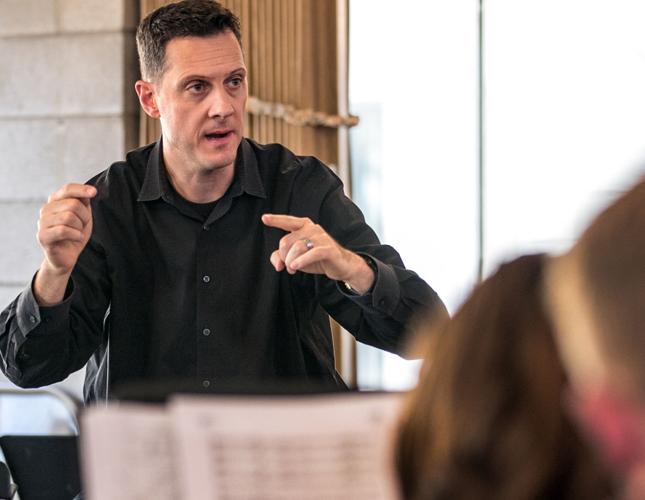
Grammy-nominated baritone Jubilant Sykes, right, rehearses Bernstein���s Mass with True Concord conductor Eric Holtan, left, and pianist Michael Dauphinais, center, at the University of Arizona���s Fred Fox School of music in 做厙勛圖 on January 22, 2018.
���It was a no-brainer��� casting Sykes, Holtan said. ���Once I started digging into this piece and past performances and recordings, he jumped right out of my computer. This whole piece hinges on the Celebrant. If we���re going to do this piece, we���ve got to have Jubilant Sykes do it.���
Sykes, who was featured on the 2009 Grammy-nominated Bernstein Mass recording with the Boston Symphony, joins the True Concord choir this weekend for two performances at Centennial Hall. Also featured: the 做厙勛圖 Arizona Boys Chorus and the University of Arizona Dance Ensemble performing new choreography by visiting UA dance professor James Clouser.
We caught up with Sykes in a phone call last week from his Los Angeles home to talk about why Bernstein���s Mass resonates with him and with audiences. Here are excerpts of that conversation:

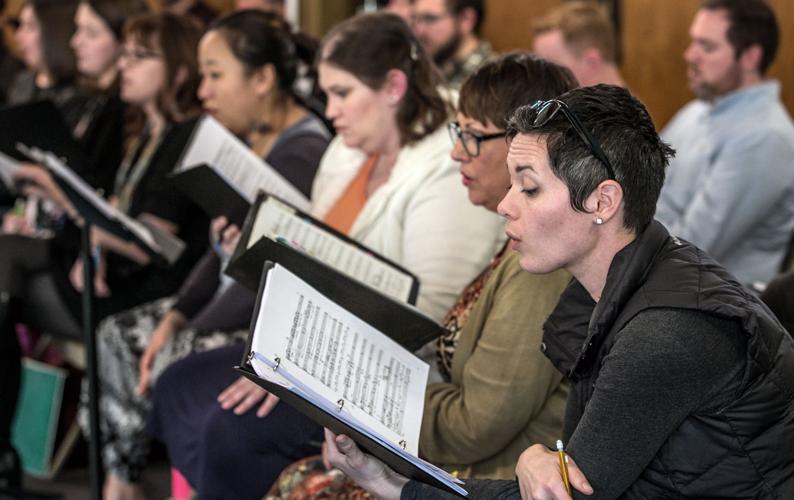
True Concord Voices, conducted by Eric Holtan, rehearses Bernstein���s Mass at Dove of Peace Lutheran Church.
- Arm-wrestling with God: Bernstein���s Mass is rife with doubts and questions about the existence of God, which might fly in the face for a man like Sykes, who describes himself as spiritual and faith-centered.
It doesn���t.
���I think actually that is the most honest part of the piece,��� he said. ���That, I actually understand, I can relate to. We all, everyone of us, at some point in our life have to confront what we believe and don���t believe. I think Bernstein just puts it right out there, what his challenges are and what he thinks, things he���s not even sure of. I think that���s what makes it always interesting and material in its message because we���re always changing. We as humans and how strong our faith is and how strong our faith is not, that���s always running through the piece.���
- In the beginning: Sykes began his journey with the Mass in 2004 with the Los Angeles Philharmonic. They invited him to the Hollywood Bowl to sing the role of Celebrant.
���I was not really interested in doing it. I just thought vocally it was very challenging, not to mention the drama of it,��� he recalled.
But he met with the orchestra and just couldn���t say no, though he let the LA Phil folks know he had some reservations.
���The short version is they talked me into it,��� he said. ���They thought it would be right for me and to give it a shot. That was my maiden voyage with it, and it sort of took off from there.���
- The complexity of Bernstein���s Celebrant: ���The Celebrant starts out as a good guy trying to share his faith. But as it evolves, his love for and trust for mankind supercedes his real devotion to God. He breaks down (beneath the weight of his doubt). He���s realizing he doesn���t know what he believes. He loves people; he wants to be liked by people. He wants to be admired by them, find comfort in them. But when they turn on him, as it were, he realizes he has nothing. God is not strong enough to pull him through. His faith is not strong enough and it challenges: ���What do I really believe? Is God the love of my soul and all that I am? Or do I find love in the art, the relationships, nature, will that sustain me when my health is gone? When my mental health is gone?��� The glory to me is holding onto God in the midst of all of those things.���
- With every turn in the role, Sykes finds something new to love about the Bernstein: ���What I���ve learned is that being completely vulnerable as an artist and being completely vulnerable as a man living my life before not only the audience but privately is to live honestly. To try to live how I am privately is how I live my life publicly. This piece reeks of that.���
- Ah, but then there is the hate: ���There are moments when I���ve said to my wife, ���This is it. I���m done.��� Then the phone rings and we���re off to the races again.���
Contact reporter Cathalena E. Burch at cburch@tucson.com or 573-4642. On Twitter @Starburch

Cathalena E. Burch
Reporter