

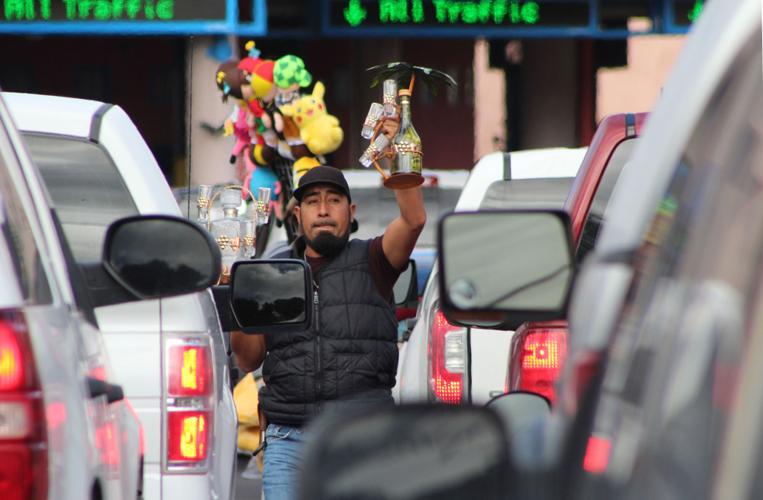
NOGALES, Sonora ��� Vendors have adopted the streets as their workplace, selling to those at border crossing lines as drivers inch their way back to the U.S. For most, it is their sole source of income.
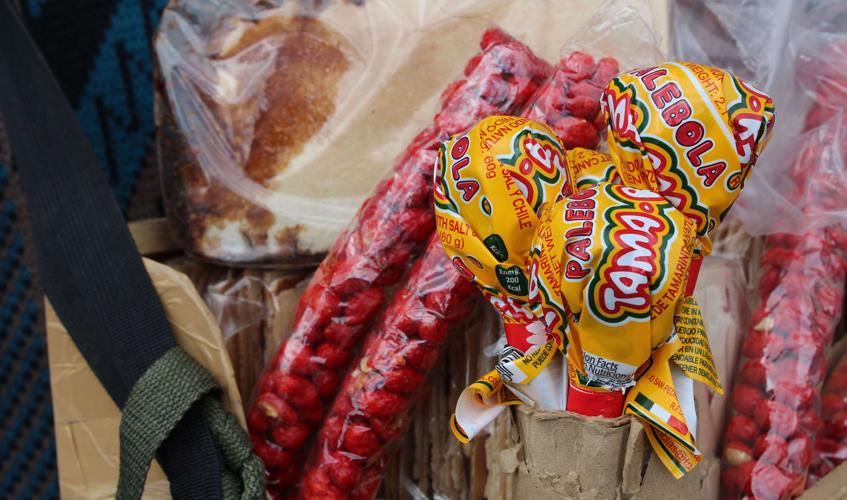
The streets are full of local businesses that attract newcomers, but dozens of independent vendors go car to car to their clients rather than waiting for clients to come to them. The vendors sell merchandise that ranges from traditional Mexican candies to ornate shot glasses to large ceramic figures of the Virgin of Guadalupe.
Fausto P矇rez has made a living selling candy and food at the border crossing for more than 20 years. With a small basket hanging from his neck, P矇rez arrives at the border inspection station at 10 every morning, he said. He offers his customers a variety of traditional Mexican candies which he buys in neighboring Hermosillo.
P矇rez is well-known among locals who regularly cross the international border. Alfonso Le籀n from Rio Rico, Ariz., 15 miles from Nogales, is one of Perez���s regular customers. As different street vendors pass by, Le籀n asks for P矇rez.
People are also reading…
���I���ve been crossing for a few years now to visit my family and Fausto is always here,��� said Le籀n, who works in Arizona but has family in Nogales.
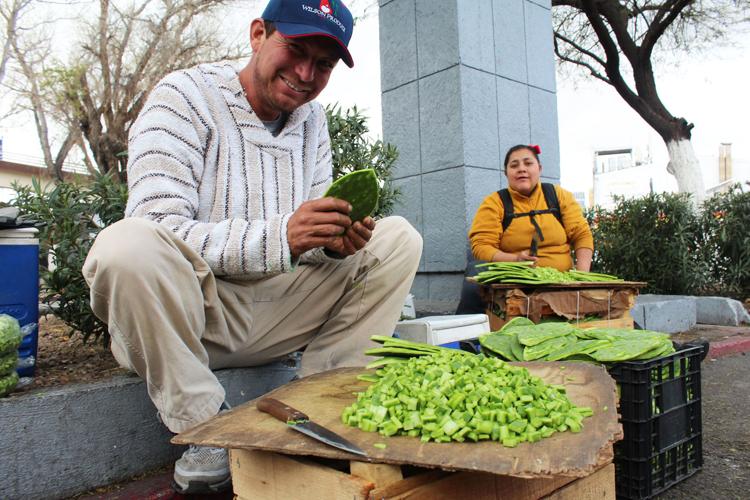
Juan Gonz獺lez is another long-time vendor who is known for selling fresh ���nopales,��� or cactus. Gonz獺lez has been going to the port of entry to sell bags of nopales for more than 25 years.
He arrives early in the morning and sets his tools and ingredients by the Plaza de las Palomas, located in front of the port of entry. There, he arranges his wares, places his wood-cutting board, and prepares the nopales. Gonz獺lez puts them in small bags and then sells them for 122 pesos, equivalent to about $6.
���Although we all sell our separate products, we���re all partners and we���ve known each other for a very long time,��� Gonz獺lez said in Spanish as he prepared to head toward prospective customers waiting in the long lines.
Every day, he and fellow vendors like Jorge ���Machaca��� Gil ��� also a full-time vendor, famous for selling fresh ���machaca��� meat ��� gather by the plaza. They meet to talk and take breaks from their long shifts at the border.
According to Gonz獺lez, the street vendors chose the location because it guarantees customers.
���There���s always going to be a line here,��� Gonz獺lez said. Each day, more than 9,000 people cross the Nogales Port of Entry, according to the U.S. Bureau of Transportation.
Other vendors like P矇rez agreed customers are always available, but he said sales can be inconsistent. This challenges vendors��� reliability on sales at the checkpoint.
���Some days, I���ll have more sales than others. You never really know how your day will go, which is why I come here every day,��� P矇rez said in Spanish.
Each vendor must have a street permit approved by the Department of License and Inspections Office in the City of Nogales, Sonora. The license must be renewed monthly. Fees vary depending on the product being sold. According to officials, monthly fees range from 85 pesos ($4.27) to 168 pesos ($8.43).
The Nogales Port of Entry is the busiest of the six non-commercial crossing stations in the region. In 2015, it accounted for 40 percent of Arizona���s total border crossing to and from Mexico, according to the Bureau of Transportation���s most recent report.
The average wait time at border crossings ranges from 45 minutes to an hour during the weekends and 30 minutes during weekdays.


