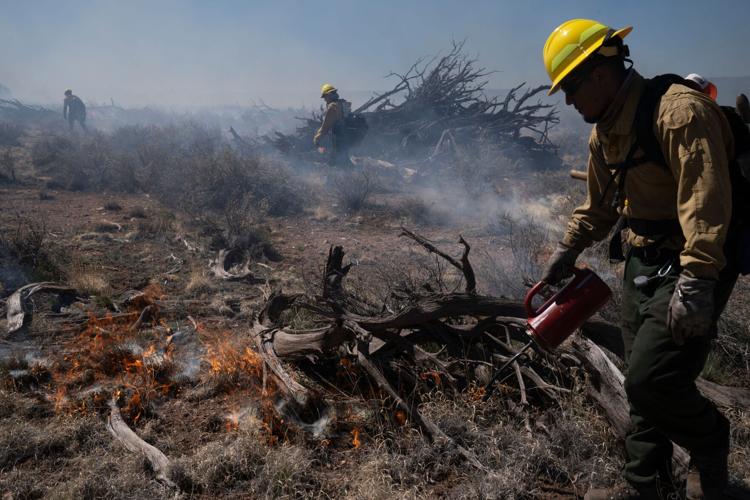
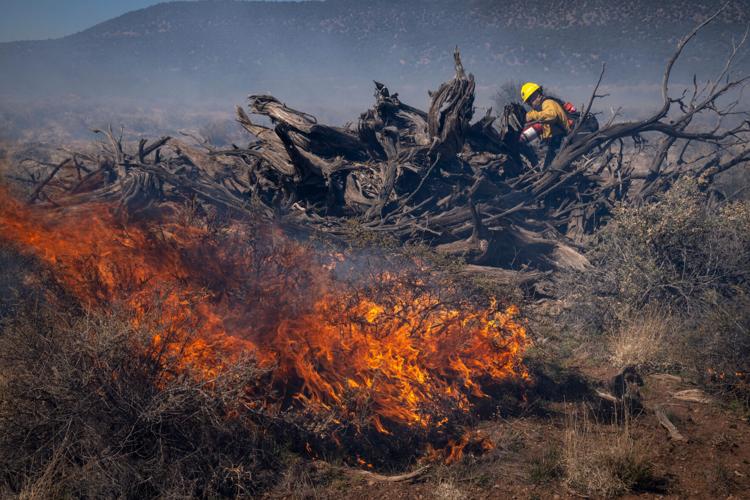
FLAGSTAFF ��� Crews with yellow hard hats and drip torches douse the grassy mesa in a mixture of gasoline and diesel. Fires swarm in their wake. Ashy embers simmer. Fallen juniper trees and bushels of brush alight. Soon, the whole field is hazy with sweet-smelling smoke.
���Diesel calms the fire down,��� said Rick Miller, a district chief with the Arizona Department of Forestry and Fire Management. ���Gasoline gives it longevity.���
The prescribed burn, on 375 acres of wild bison rangeland, is 15 years in the making. Burns don���t always take so long to pull together, usually just a few years, but Miller���s plans were stalled because of drought.
������It was pretty bad for a few years,��� he said. The land where he stood had been hit hard. What was once a sea of continuous grass had turned patchy. Applying fire could���ve diminished the only available forage for the plain���s roaming bison.
People are also reading…
For the past 31 years, Arizona has seen an average of 11 inches of rain every year ��� an inch below the long-term average. The ongoing ���megadrought��� is the driest 22-year period in the last 1,200 years, said Ivan Knudsen, a fire communications specialist with the U.S. Forest Service. Though the desert has seen cycles of 35-year dry spells before, scientists increasingly worry that climate change could make the shift more permanent.
������We have this steady warming that is magnifying the background pattern of periodic drought that has always been a part of these ecosystems,��� said Peter Ful矇, a professor in the Department of Forestry at Northern Arizona University.

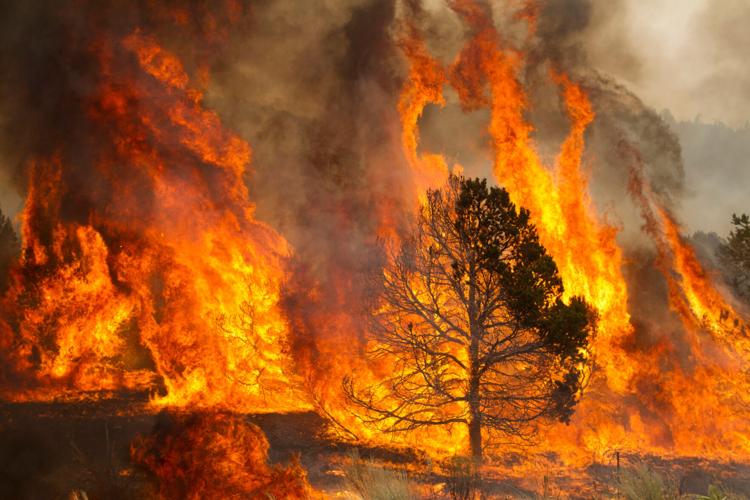
The Wallow Fire ravaged Eastern Arizona in 2011. It burned a total of 538,049 acres.
Over a century of fire suppression, coupled with climate change, has turned wildfires bigger and hungrier. Across the Western United States, drought is complicating wildfire management and prevention, sometimes stalling planned burns. Longer, drier and hotter summers are extending the fire season and shortening the window of available time to treat the land, even as experts say we aren���t burning enough.
Drought is changing the landscape too, creating competition for resources among the native flora and, in some parts of Arizona, sparking wildfires where they almost never occurred naturally.
As the wildfire season heats up, land managers and fire experts are looking to the past and to the future for answers.
From the '10 a.m. rule' to Smokey to controlled burns
Three days after graduating high school in 1985, Miller joined the Forest Service. At the time, he wasn���t particularly qualified for ���chasing wildfires,��� he said. He knew how to work a chainsaw. He���d cut wood plenty of times with his dad, and he spent every waking moment of his childhood in the woods around northern Arizona.
When he started, he mostly remembers responding to active wildfires. Back then, the Forest Service had only recently abandoned its ���10 a.m. rule,��� which said that all wildfires had to be extinguished by 10 a.m. the morning after they were reported.
It was the beginning of the end for an era of all-out fire suppression, best exemplified by the furry, all-knowing, pointed finger of Smokey Bear and his famous decree, ���Only YOU can prevent wildfires,��� (and a lesser-known slogan from the 1940s, ���Smokey says ��� Care will prevent 9 out of 10 forest fires���).
������It's actually very recent that people decided fire was universally bad,��� said Stephen Pyne, a fire historian, professor emeritus at Arizona State University and self-described pyromantic (not to be confused with pyromania or pyromancy). Mostly, he said, that change was driven by foresters in the 19th and 20th centuries.
When the Forest Service was established in 1876, its mission was to protect forests across the country from threats like logging and wildfire. That resulted in an ethos of fire suppression that lasted through much of the 20th century. In the Southwest, frequent fires halted abruptly after 1879, tree ring records show. Fuels, like dead brush and pine needles, built up. Forests grew dense.
Fire has always played a role in forests. It recycles nutrients, promotes plant growth and supports habitats, according to Ful矇. The way fire behaves in a landscape is called its fire regime, and those regimes vary across the state. In northern Arizona, the landscape evolved with fire. Historically, the mixed conifer forests of northern Arizona���s Mogollon Rim burned at low intensity as frequently as every 2 to 8 years, according to tree ring records dating back to the 1670s.
But fire suppression, logging and grazing fundamentally altered that historic pattern, in turn altering the forests.

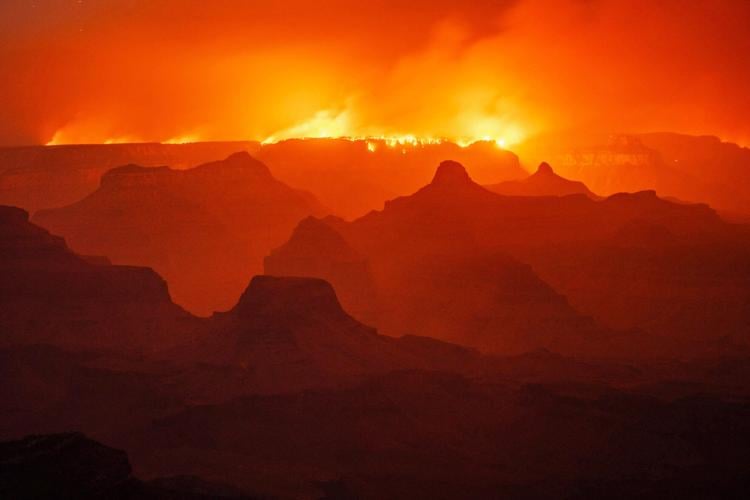
The Dragon Bravo fire burns on the North Rim of the Grand Canyon as seen from the South Rim in July 2025
Ful矇 likened fire to exercise. If you exercise regularly, it���s not as hard. But if you give it up for a long period ��� in the case of fire, that period was 150 years ��� then you aren���t as exercise-adapted. That���s what���s happened with suppression.
���Effectively, our forests are very out of shape for dealing with hot, dry, windy conditions,��� Ful矇 said.
Long before settlers moved west, Indigenous tribes used fire in cultural burnings to steward the land. Frank Kanawha Lake, a research ecologist with the USDA Forest Service and wildland firefighter of Karuk ancestry, likens cultural burnings back to a ���tribal philosophy of fire as medicine.��� In the 1800s, cultural burns were banned in many states.
���When fire is returned to landscapes, it creates a heterogeneous ecosystem and lots of plant diversity,��� Dr. Melinda Adams, a San Carlos Apache fire scientist at the University of Kansas, told The Arizona Republic last November. That diversity makes forests more resilient to wildfire.
Around the mid-20th century, ecologists and foresters started wondering if Smokey was wrong. Maybe preventing all fires was not the best way to care for the land. Maybe care meant bringing fire back to the forests and grasslands that burned at regular intervals for millennia.
������Fire is very much a natural part of this landscape and we've disrupted that,��� said Noah Baker, a wildfire, climate, and community health specialist at the Flagstaff Fire Department. ���Now, we're trying to backtrack and make it right.���
Even the language around controlled fire acknowledges that it is restorative: prescription, treatment. Still, prescribed fire wasn���t widely adopted by all agencies equally. The Forest Service didn���t change its ways until 1978.
In 2000, a new national fire plan brought emphasis ��� and funding ��� to prescribed fire. Wildfires were getting bigger and more robust, Miller said. He was witnessing what fire ecologists call the ���wildfire paradox��� ��� fire suppression equals more severe wildfires in the long run.
That���s around the time he remembers the Forest Service ramping up prescribed fire efforts in Arizona and, in 2016, the Department of Forestry and Fire Management separated from the State Land Department and became its own agency.
Six years after retiring from the Forest Service, Miller joined the ranks at the forestry department. Now, he manages and plans prescribed burns, drafting 45-page outlines for each project, taking into account weather conditions, objectives and risk.
Miller���s burn, dubbed the "Raymond Rx," is phase one of a multi-year effort to improve the rangeland for the bison and minimize the risk of future wildfire. Eventually, the department will return to the plot of land and burn it again, treating the land around the state like clockwork ��� a repeated but controlled pattern to mimic the way fire once moved naturally.
The moment the snow is gone, 'fire season starts'
Before they started burning, Miller���s crew lit a test patch on the land to make sure the fire would behave. Then the work began.
A staticky message crackled on his radio, ���Your smoke is coming across real clean. No issues,��� said a voice on the other end as he weaved through the fire line on a UTV.
Prescribed fire is a careful science. The Rx depends on the weather. Wind, precipitation, even relative humidity, what Miller calls ���RH,��� can shift at the last minute and postpone a burn.
���Timing is everything in this world,��� he said. It all depends on a Goldilocks kind of ���just right.���
Usually, those conditions align in early spring and fall, before snow has fallen and just as it���s melting. The days are short, and the heat is minimal. But the fire season is changing.
In many parts of the West, this past winter was the warmest on record. In Phoenix, record-setting February heat was followed by eight consecutive 100-degree days starting on March 18. At higher elevations, the warmer-than-usual winter meant that precipitation fell as rain instead of snow. What little snowpack accumulated melted quickly.
���The moment we don���t have any snow left, that���s when fire season starts,��� Baker said.

In March, the Arizona Department of Forestry and Fire Management crews ��ignited the Raymond Prescribed Fire southeast of Flagstaff.
Winter precipitation is kind of like a battery. Over the course of spring, gradual heat melts the snowpack, slowly releasing moisture into the soil, he said. But sudden and early heat waves cause snow to melt and evaporate more quickly. Usually, moisture evaporates over the early summer months, making June, right before monsoon season, the most fire-prone.
���We already are four to six weeks ahead of normal on our vegetation drying,��� said John Truett, fire management officer at the state forestry department, at a briefing in March.
Drier vegetation can mean greater risk in controlling and managing a burn, Miller said.
Since the 1980s, average temperatures have been on the rise globally, and drought across the West doesn���t seem to be relenting. As it gets hotter and drier, the window for prescribed burning is shrinking. Typically, treatments start in spring. Come late April, fire managers direct their attention away from prescription to the impending fire season.
In October, before snowfall, treatment starts up again. But a 2023 study showed that longer summers could reduce suitable days for burns by 17%. States in the Southwest will bear the brunt of that loss.
To cope, Knudsen said fire managers are burning smaller areas, drafting more conservative burn plans and using mechanical thinning where burn conditions aren���t met.
Even as that window is shrinking, many fire experts say we aren���t burning enough.
���The reality of it is, I could burn every single day that the conditions were right and not make a dent in what needs to happen across a lot of this country, in a lot of places in Arizona,��� Miller said.
Historic fire regimes burned at a far faster rate than land managers have been able to replicate.
Christopher Roos, an environmental archaeologist and professor of anthropology at Southern Methodist University in Texas, looked at ancient tree rings to show how Western Apache tribes used frequent and fragmented fires, what he calls a mosaic, to disrupt the effect drought and other climatic factors had on fire activity.
���They disconnected the whole machine of climate driving fire,��� he said in an interview with The Republic last November.
But the Western Apache technique, a patchwork-style stewardship, is hard to manage these days. Fire managers have to jump at the chance to burn because they aren���t sure when it will come again ��� that means when they burn, they need to get large swaths of land.
In the face of climate change-fueled drought, Pyne said we need to think about fire more systemically, not just as a seasonal or emergency response. That could mean doing more burns during the winter, if warmer weather allows.
������It may be that our prescribed fire season moves into December,��� said Andi Thode, a professor of fire ecology at Northern Arizona University. But in those off-season months, agencies have limited resources. Mostly, they rely on seasonal crews who might not be as available during other parts of the year.
������We are doing our part to maintain the ecosystem to the best degree that we can,��� Miller said.
Managing wildfires where frequent fire regimes never existed
In the rocky reaches of the Sonoran Desert, charred saguaro cactuses, miraged by heat, wave with many limbs. In between them, a host of invasive flora have taken hold: flowery globemallow, feathery cheatgrass, yellowy stinknet.
Six years ago, 193,455 acres of the Tonto National Forest burned, blazing to a size larger than nearby Mesa. Flames spread hungrily, consuming those grasses as fuel.
������The situation with the desert is a lot different than the situation in our forests,��� Thode said. The Sonoran Desert is not adapted to fire the way that the pine forests are. Where the north had a frequent fire regime, the desert rarely burned.
���Plants like ponderosa pine trees can withstand low-intensity grass fires,��� she said. Thick bark and high branches protect them. Saguaro, palo verde, and ocotillo have no such adaptations because they never needed them.
In the 20th century, invasive grasses like buffelgrass were planted for cattle grazing, and others for erosion control. The grasses sprawled out across wide open patches of land. Before, if lightning struck and caused a fire to break out, it wouldn���t go far because no underbrush existed to carry the flames.
���Right around ���2005, there was kind of a tipping point,��� said Ben Wilder, a biogeographer and desert ecologist in 做厙勛圖. Red brome and buffelgrass growth exploded. Now, in many parts of the desert, fire spreads readily.
The timing of precipitation in the desert matters.
������It���s a paradox here. Rains up in the forest really will temper fire danger. Whereas in the deserts, it's the opposite,��� he said. Autumn and winter rain cause invasive grasses to flourish. Come spring, they dry out.
���Those fall rains matter a lot,��� Thode said. ���They create winter fuels that then turn into spring fires.���
Ongoing drought weakens native plants, Knudsen said. Lower precipitation is stressing all desert vegetation, but plants like buffelgrass are able to quickly take advantage of moisture, making them more drought-resistant in the long run. Increasingly, they are crowding out native plants.
Preventing events like the Tonto���s 2020 Bush Fire requires a toolbox of strategies. Ecologists and fire managers are still experimenting to figure out what works best.
������There are a lot of different treatments that are being assessed right now,��� Thode said, like herbicide spraying, localized propane torching, and pruning.
Creating wildfire resilient ecosystems in the Sonoran Desert isn���t really about returning fire to the landscape at a large scale, like it is up north, because fire was never really around in the first place. But in 2023, the Tonto National Forest began doing broadcast burns in places where invasive grasses are abundant, Knudsen said. Forest managers in the Tonto have also partnered with the University of Arizona to study targeted grazing along roadsides.
������It���s a lot of work. These treatments are expensive. They're time-consuming. And we have big landscapes to cover,��� Thode said. ���This is definitely what we call a ���wicked problem��� in science.���
What lessons will emerge from the Dragon Bravo Fire?
Last summer, in a helicopter hovering above the Grand Canyon, Baker remembers watching the Dragon Bravo fire swarm the North Rim. Maybe it���s that he���s six feet tall and that he���s claustrophobic, or afraid of heights, but that day in the air, he nearly had a panic attack.
He remembers looking down at where the wildfire met the Grand Canyon���s edge.
���It just kind of stopped there and trickled out while fire ripped in the other direction,��� he said. It moved aggressively into the wind. The helicopter coasted over a house he once lived in that had burned to the ground.
The embers of that fire, ignited in July by lightning, still burn in the state���s collective memory. Initially, firefighters working on Dragon Bravo tried a ���control and contain��� strategy to keep the flames from spreading. Weather conditions seemed right for this approach ��� one that crews often use to manage wildfire without totally suppressing it, getting what ecological benefit they can for the land.
But then hot, dry winds blew in from the northwest. Humidity plummeted. Fire jumped across containment lines and spread ferociously.
The Dragon Bravo Fire burned across over 145,000 acres of public lands, destroying 106 structures, including the historic Grand Canyon Lodge. It was a three-month saga and wasn���t completely contained until September.
In the aftermath, the federal agencies that managed the burn faced more heat ��� Gov. Katie Hobbs and Sens. Ruben Gallego and Mark Kelly, both D-Ariz., criticized officials for their approach and called for an investigation.
���While the flame was started with a lightning strike, the federal government chose to manage that fire as a controlled burn during the driest, hottest part of the Arizona summer,��� Hobbs said in a statement last July.
A 2025 investigation by The Arizona Republic revealed that National Park Service officials disregarded the Grand Canyon���s fire management plan when they decided to let the fire burn.
Drought, unprecedented heat and recent megafires like Dragon Bravo are inducing a new federal sentiment.
������There is a significant amount of fear in politics about the conditions that we're experiencing, especially this year,��� Baker said.
In January, the U.S. Department of the Interior said it would establish a new wildfire management agency. Where the DOI used to oversee firefighting for the National Park Service, the Bureau of Land Management, the Fish and Wildlife Service and the Bureau of Indian Affairs, it���s now consolidated that responsibility under one roof ��� the Wildland Fire Service.
Its primary mission: to extinguish fires on public lands as quickly as possible, according to a February statement made by the Wildland Fire Service���s Chief, Brian Fennessey, as reported by Politico.

In March, Arizona Department of Forestry and Fire Management crew members used drip torches to ignite the more than 500-acre Raymond Prescribed Fire about 25 miles southeast of Flagstaff.
Eleven members of Congress, including Kelly, signed a letter to the Secretary of the Interior in February explaining their apprehension about plans for the new fire service. The change, they wrote, is rapidly restructuring wildfire management during what���s expected to be a significant fire season and decouples fire management from land stewardship, leaving land management agencies with less autonomy.
During a Senate hearing on April 22, Interior Secretary Doug Burgum said the Dragon Bravo Fire could have been avoided, marking a shift from the National Park Service���s stance last summer ��� that the fire was ���expertly handled.��� As Interior Secretary, Burgum oversees the National Park Service and all the other agencies now merged under the Wildland Fire Service.
���It's going to be a year of suppression,��� he said. ���When the fire begins, we'll put it out.���
The recent position of the federal government reminds Baker of the 10 a.m. rule. But fire officials have some leeway in what that looks like on the ground.
���We have the decision making abilities at the local level to say, ���hey, this fire might have ecological benefits to an area. We are going to keep that initial smaller fire alive. We're going to let it burn, but we're gonna keep it in check,������ he said.
That���s what he calls indirect fire suppression. It���s a lot like a prescribed burn, except that it���s an active wildfire. The new federal approach still gives local decision makers the choice between using indirect or direct suppression, he said. Still, he worries the policy and increased political pressure this year could put firefighters in danger.
It���s hard to know what the current administration���s intentions are with the new reorganization, Pyne said.
���It could be a good thing, it could be a disaster,��� he said. Direct suppression can be successful in the short term, but it doesn���t get to the root of the problem.
���It's like a blanket antibiotic,��� he said. ���If you start throwing out antibiotics every time anyone gets sick, suddenly all you've done in the end is create a lot of drug resistant bacteria. The bacteria that remain are the ones you can't control anymore.���
With more direct fire suppression, that���s sort of what the fire scene would look like, he said. What he���d like to see instead is an investment in our ecological infrastructure.
The ethos of cultural burning could be more relevant than ever before: fire as a tool for a changing climate.
���We have an opportunity to approach how we rebuild our relationship with fire. Suppression to stewardship,��� Adams said last November. ���We have to change.���
For millennia, just as it���s shaped our forests, fire has shaped our evolution. Fire has always been a human companion, Pyne said. Even before we were human in the way we are now, our ancestors were cooking with it. We built our homes around hearths and fireplaces. We used fire to light our way down unknown paths, into uncertain futures. In the face of climate change, we might do something similar.